+86-13073105066
admin@longshubearing.com



Bearing support
2026-10-16
The essence of the design of the bearing support structure is to find a balance between “fixed” and “free”.Referring to the typical examples in the “Mechanical Design Manual”, you can start from three basic forms and three configuration methods to quickly establish selection ideas.
Three basic support forms
Fixed support at both ends: the two fulcrum points of the shaft are axially fixed, the structure is simple, and it is suitable for working conditions with short shafts and small temperature differences.
Fixed-swimming support: one end is fixed, and the other end can swim axially.When the long shaft is working, thermal expansion is generated due to temperature rise, and the swimming end can “absorb” the elongation to avoid the shaft being stuck or excessive internal stress. It is a general solution for long shaft transmission.
Swimming support at both ends: both ends can be moved axially, and it is mostly used for special occasions such as herringbone gears that require two-way floating.
Three bearing configuration methods
When angular contact bearings (angular contact ball bearings, tapered roller bearings) are used in pairs, there are three common arrangements:
Back-to-back (DB): High rigidity, strong anti-overturning torque ability, suitable for support with large span.
Face-to-face (DF): Easy to install and adjust, and has good adaptability to the thermal elongation of the shaft.
Series (DT): The loads are superimposed in the same direction, which is used to withstand the working conditions of large one-way axial forces.
Selection ideas for typical working conditions
Deep groove ball bearings: simple structure, low cost, suitable for light and medium loads, high speed occasions, often used as fixed ends or swimming ends alone.
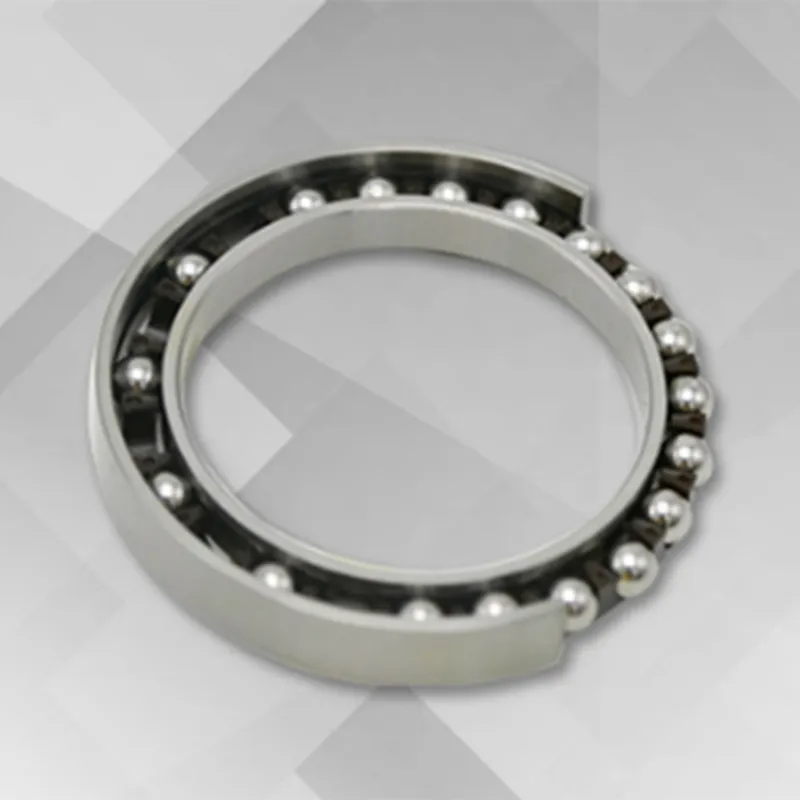
Angular contact ball bearings: they can withstand combined loads and have better rigidity after being configured in pairs. They are commonly used in precision drives such as spindles and gearboxes.
Tapered roller bearings: strong carrying capacity, suitable for heavy-duty and impact conditions, such as reducer output shaft, wheel support, etc.
Taking column-type jib cranes as an example, the upper and lower fulcrum points of the column need to withstand greater radial force and overturning torque, and the back-to-back configuration of tapered roller bearings or angular contact bearings is often used; in tapered cylindrical gear reducers, high-speed shafts are mostly combined with deep groove balls or angular contact bearings, and the low-speed heavy-duty end tends to tapered roller bearings, and with a fixed-swimming structure to deal with the thermal elongation of the shaft.
By mastering these combinatorial logic, a reasonable support scheme can be quickly constructed according to the shaft length, load, speed and temperature rise conditions.